 Helldivers 2
Guía para principiantes de Helldivers 2 Freedom's Beacon

Respuesta rápida: Helldivers 2 Freedom's Beacon es más fácil para principiantes si te centras en aprender las entradas de stratagems, mantenerte con tu escuadra, gastar los recursos iniciales en mejoras prácticas y tratar la supervivencia y la extracción como algo más importante que ir a por cada pelea.
Helldivers 2 funciona porque te lanza a una guerra cooperativa caótica y de mucha presión, y espera que aprendas haciendo. Al principio suena intimidante, pero el juego es mucho más amable cuando entiendes su ritmo: aterriza, lee el objetivo, muévete con intención, llama las herramientas correctas y sal antes de que la avaricia hunda a tu escuadra. Para cualquiera que empiece con la experiencia de Helldivers 2 Freedom's Beacon, el verdadero obstáculo no es la puntería pura. Es tomar decisiones en medio del caos.
Eso importa porque estamos ante un juego cooperativo en vivo enorme, con una base de jugadores muy amplia. La página oficial de Steam ahora mismo lo marca como "Mostly Positive" con 75.1% positive across 1151055 reviews Source, y HowLongToBeat informa de unas 32.43 hours for the main story, 65.01 hours with extras, and 89.29 hours for completion Source. En la práctica, eso significa que tus primeras sesiones deberían servir para crear hábitos, no para correr a "terminar" nada. Estás aprendiendo un shooter cooperativo de larga duración, no cerrando una campaña corta para pasar a otra cosa.
What Helldivers 2 Freedom's Beacon Means for New Players
Helldivers 2 Freedom's Beacon se entiende mejor como tu ventana inicial de aprendizaje, donde los buenos hábitos pesan más que la cantidad de desbloqueos o empujar la dificultad. Si eres nuevo, piensa en esta fase como entrenamiento básico con munición real: no estás intentando liderar la tabla, estás intentando ser fiable.
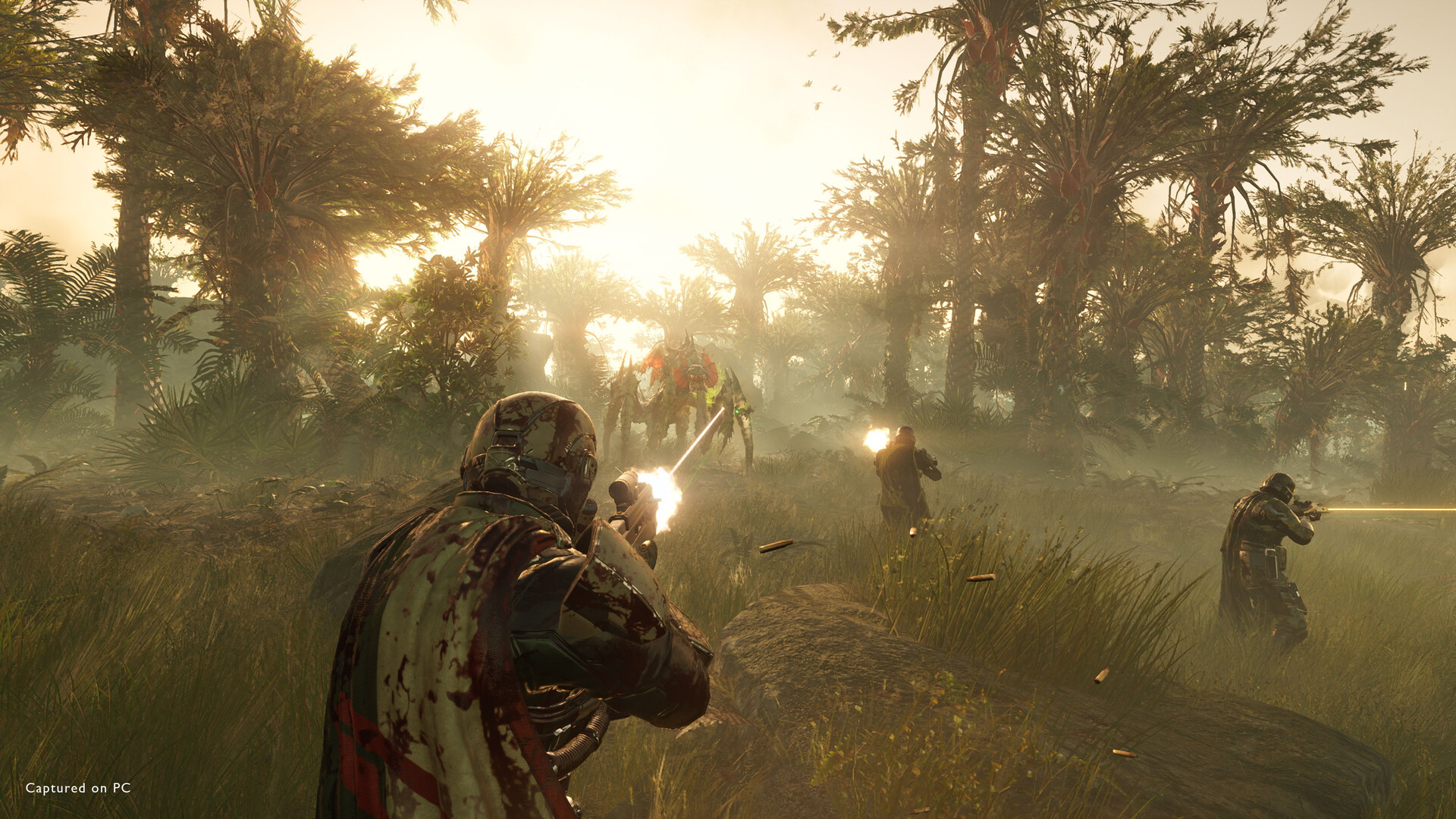
La estructura básica es simple. Te despliegas en un planeta, completas uno o más objetivos de misión, lidias con patrullas enemigas y refuerzos, y luego extraes vivo si puedes. El juego se vende en Steam como "a fast, frantic, and ferocious third-person shooter" Source, y esa descripción encaja. A menudo vas a estar gestionando a la vez el disparo del arma principal, granadas, armas de apoyo, lectura del mapa, terminales de objetivos y llamadas de stratagems.
Para los principiantes, hay tres sistemas que lo definen casi todo:
- Stratagems: llamadas codificadas para suministros, armas de apoyo, torretas y potencia de fuego pesada. Algunos ejemplos son reabastecimientos, emplazamientos defensivos y apoyo orbital.
- Objectives: la verdadera razón por la que estás en el mapa. Algunos ejemplos incluyen activar terminales, destruir estructuras hostiles o recuperar equipo crítico para la misión.
- Extraction pressure: la fase final en la que muchos jugadores nuevos se ponen nerviosos, se quedan demasiado tiempo o se dispersan. Algunos ejemplos incluyen pedir la extracción demasiado pronto, quedarse a la intemperie cerca de la zona del shuttle o gastar las herramientas pesadas antes de la última defensa.
La lección clave para principiantes es que el combate es un medio para completar objetivos, no el objetivo en sí. Muchos jugadores nuevos tratan cada patrulla como un duelo obligatorio. Las escuadras veteranas hacen lo contrario. Pelean cuando necesitan espacio, se cuelan por donde pueden y guardan los tiempos de recarga para amenazas de verdad como enemigos blindados, oleadas durante subidas de enlace o asaltos a la extracción.
Por eso también la fase de principiante en Helldivers 2 Freedom's Beacon dura más de lo que la gente espera. Puedes desbloquear equipo pronto y seguir jugando como novato si repites los mismos errores de posicionamiento. En cambio, un jugador más nuevo con un rifle básico, buen espaciado y buen timing de stratagems puede aportar muchísimo en operaciones de nivel medio.
Si quieres una mentalidad simple para cada misión, usa esta: mantente lo bastante cerca para apoyar al equipo, lo bastante lejos para no arrasarse entre sí y siempre saber cuál es el siguiente objetivo. Solo ese hábito ya limpia un montón de fallos tempranos.
First-Hour Checklist
Tu primera hora en Helldivers 2 Freedom's Beacon debería dedicarse a crear memoria muscular, no a perseguir dificultad ni intentar farmearlo todo a la vez. La meta es salir de esa primera sesión sabiendo cómo moverte, llamar apoyo, leer el mapa, completar objetivos y extraer sin convertir cada misión en un desastre.
Usa esta lista más o menos en este orden:
Finish the tutorial and pay attention to the small rules it teaches. El tutorial no rellena espacio. Te presenta el movimiento, el manejo del arma, los stims, las granadas y la verdad simple de que el fuego amigo siempre forma parte del campo de batalla. Si lo ignoras, gastarás tus primeras misiones reales matando accidentalmente a compañeros con lanzamientos malos y líneas de tiro descuidadas.
Learn your first few stratagem inputs until you can do them under pressure. Empieza por lo esencial en lugar de por ataques vistosos. Reabastecimiento, un arma de apoyo fiable y una llamada básica defensiva u ofensiva te entrenan mejor que stratagems complicadas de alto impacto que no puedes introducir rápido. Practícalas mientras te mueves, boca abajo y con enemigos cerca.
Run low-pressure missions before touching harder operations. Elige contenido fácil y úsalo como laboratorio. Aprende cuánto tarda en activarse un terminal, cómo escalan las alertas enemigas y cómo se siente la extracción cuando no te están aplastando. Aquí deberías probar ejemplos como aguantar un objetivo tipo radar, limpiar un nido o un fabricator, o moverte entre puntos marcados sin aggroear a cada patrulla.
Open the map constantly. Los jugadores nuevos se ciegan. Crea el hábito de revisar terreno, marcadores de objetivo, rutas de patrulla y distancia a la extracción. Si tu escuadra va hacia el este y tú sigues saqueando al oeste, normalmente el mapa ya te había avisado antes.
Practice one anti-armor answer and one crowd-control answer. Todavía no necesitas un loadout perfecto, pero sí cobertura. Una escuadra que solo lleva rifles sufre contra enemigos blindados. Una escuadra que solo lleva herramientas antitanque queda sepultada por las oleadas. Ejemplos tempranos de buen equilibrio son un arma de apoyo para objetivos grandes y, además, granadas, sentries o negación de área para las oleadas.
Extract at least a few times successfully before you experiment. La extracción enseña espaciado, disciplina de disparo y timing de recursos. También es donde el pánico de principiante aparece más rápido. Aprender a sobrevivir a la última defensa es más importante que rascar un objetivo secundario extra.
Spend a few minutes in menus reading what your gear actually does. Muchas malas decisiones tempranas vienen de no entender el rol de las herramientas. Algunas stratagems son mejores para fortificar un punto, otras para borrar blindaje y otras para recuperación de emergencia. Lee antes de desplegar.
Play at least one mission focused on objectives rather than kills. Esto te ayuda a romper la costumbre típica de shooter de medir el éxito por la cantidad de enemigos. En Helldivers 2, una misión limpia con objetivos y peleas controladas suele ser mejor que un baño de sangre largo que agota suministros.
If you only remember three first-hour priorities, make them these:
| First-Hour Priority | Why It Matters | Good Early Example |
|---|---|---|
| Learn core stratagems | You need support tools on demand | Resupply plus one support weapon |
| Stay with the squad | Solo drifting causes most early deaths | Move as a loose pack between markers |
| Extract consistently | Successful missions teach the full loop | Finish objectives and leave without greed |
A final note here: because the broader game can last well beyond a quick weekend, with HowLongToBeat listing 32.43 hours for main story pacing alone Source, there is no advantage in rushing your first hour. Use it to become stable, not impressive.
También te puede gustar
- Helldivers 2 fourth faction alternative multiple enemies planet why Beginner Guide
- Helldivers 2 Which enemy faction do you enjoy fighting in: Beginner Guide
- Helldivers 2 Super Destroyer Screen Display Interactive Update: Beginner Guide
- Helldivers 2 Ground All Terrain Extraction Rig GATER Beginner Guide
- Helldivers 2 Reviewed by Game878Helldivers 2Read Full Review Story5Gameplay9Visuals9Audio8Value forMoney8 Beginner Guide
Resumen
Your early resource priority in Helldivers 2 Freedom's Beacon should be practical unlocks first, durable account progress second, and luxury experimentation last. Beginners get into trouble when they spend too broadly and end up with lots of toys but no clear answers to the problems they actually face in missions.
The exact names and progression paths can shift as the live game evolves, so it is safer to think in categories. In the current meta, your resources usually feed three different goals: unlocking tools, strengthening your ship and account-wide support, and opening optional gear variety. The beginner mistake is treating all three goals as equally urgent.
Use this spending order:
First priority: unlock dependable mission tools. Your earliest investments should solve common field problems. You want access to:
- a reliable support weapon for armored enemies
- a consistent resupply rhythm
- one defensive call-in such as a turret or emplacement
- one offensive panic button such as an airstrike or orbital option
Practical examples are easier to understand than theory. If your squad struggles against a heavily armored target, a support weapon unlock matters more than a cosmetic armor preference. If you fail extraction because the zone collapses, a defensive stratagem often gives more value than another niche gun.
Second priority: ship or account upgrades that improve mission consistency. Upgrades that make your stratagem package more dependable are usually better than upgrades built around rare edge cases. Think in terms of shorter downtime, better utility, or stronger support infrastructure rather than flashy one-moment power. Anything that makes your regular kit smoother across every mission tends to pay off faster.
Third priority: broader weapon and armor options. Variety is good, but only after you have a backbone loadout. Many new players unlock sideways options too early, then wonder why nothing feels stronger. A new primary weapon may change how you handle light enemies, but it rarely fixes poor anti-armor coverage or weak objective defense by itself.
Fourth priority: hoard premium-value currency until you know what role you like. The patch context around anti-cheat measures specifically mentions Super Credits as the in-game currency tied to warbonds and purchasable items Source. That is exactly why beginners should avoid impulse spending. If you later discover you prefer anti-armor support, area denial, or mobile skirmishing, you will want flexibility.
Here is the cleanest beginner priority table:
| Priority Order | Spend Early | Delay Until Later | Reason |
|---|---|---|---|
| 1 | Core stratagem tools | Niche experiments | Missions punish missing utility more than missing variety |
| 2 | Consistency upgrades | Cosmetic preference picks | Reliable cooldowns and support matter every run |
| 3 | Role-expanding weapons | Duplicate role gear | Build one solid role before branching |
| 4 | Premium-value currency | Impulse unlocks | Saving gives better long-term choice control |
What should you hoard? Anything scarce that can unlock meaningful long-term options later. What should you spend freely? Early progression aimed at making your loadout functional. What should you craft or unlock first? The things that answer real mission failure points you have already seen: armored enemies, extraction pressure, and supply starvation.
A useful self-check is this: after each mission, ask what actually caused the trouble. If the answer is "we ran out of anti-armor," spend toward that. If the answer is "we got flooded while defending a terminal," spend toward control or fortification. Let the battlefield tell you your next purchase.
How to Fight Smarter in Early Missions
The smartest way to fight in Helldivers 2 Freedom's Beacon is to treat positioning, target priority, and cooldown timing as more important than raw aggression. New players often believe they need better aim. Usually they need better choices.
Start with positioning. The game punishes clumping and punishes isolation, which sounds contradictory until you get used to it. You want to move as a spread squad. Close enough to revive, share supplies, and combine fire. Far enough that one grenade, one charger rush, or one orbital mistake does not flatten the whole team. Good spacing is visible in simple scenarios: one player works a terminal while two hold angles and one watches the flank; or the squad retreats together from a wave instead of four players sprinting in four directions.
Target priority is the second big skill. Not every enemy deserves immediate fire. In most fights, you should focus on:
- enemies that can quickly overrun the team
- armored threats your current weapons cannot casually handle
- units pressuring an active objective
- patrols that will trigger a much larger fight if left unmanaged at the wrong moment
Examples make this clearer:
- If your squad is uploading data and a wave is closing in, clear the pressure around the objective before chasing distant targets.
- If a heavily armored enemy enters the fight, the player with the correct support weapon should handle it while others manage escorts.
- If a patrol has not noticed you and your team is low on ammo, bypassing it is often the best "kill."
Cooldown timing is where many beginners waste runs. They throw major stratagems at the first sign of trouble, then have nothing ready when the real crisis starts. A better habit is to classify tools by job:
- use routine tools for routine pressure
- save high-impact calls for armor clusters, objective defense, or extraction
- drop resupplies before the team is fully empty, not after everyone is desperate
You should also learn when not to stand and fight. Retreat is not failure in this game. If a position is bad, move. If a breach spirals, break contact. If your squad is spending too much time farming a pointless fight, ping the objective and reset the pace.
This is one of the reasons the game has lasted with such a large audience, with SteamSpy estimating ownership at 20,000,000 .. 50,000,000 Steam accounts Source. There is a deep skill curve hidden under the shooter surface. It is not just about shooting better. It is about solving chaos faster than it grows.
For beginners, the best early combat pattern is simple:
- identify the real threat
- use the smallest tool that solves it
- keep moving toward the objective
- preserve something strong for extraction
That pattern will carry you much farther than trying to win every firefight through stubbornness alone.
Errores comunes
The most common Helldivers 2 Freedom's Beacon mistakes are all fixable, and most come from habits players import from other shooters. If you correct these early, your success rate jumps fast.
Mistake: Fighting every patrol you see.
Why players fall into it: many co-op shooters reward constant clearing, so new players assume every enemy group must be deleted.
Fix: only engage patrols that block movement, threaten an objective, or are about to alert a larger force. Otherwise, move around them and keep mission tempo.Mistake: Entering missions without anti-armor coverage.
Why players fall into it: basic rifles feel comfortable early, so squads overinvest in general-purpose guns.
Fix: make sure at least one or two players bring reliable armor answers. In a random group, bring one yourself rather than assuming someone else did.Mistake: Calling stratagems in dangerous or selfish spots.
Why players fall into it: under stress, players drop supplies or fire support exactly where they are standing.
Fix: throw call-ins slightly ahead of team movement, off to the side of firing lanes, or onto enemies with clear warning. Check teammate position before confirming.Mistake: Burning all heavy cooldowns before extraction.
Why players fall into it: early fights feel dramatic, so players overreact and spend everything too soon.
Fix: save at least one major answer for the end of the mission. Extraction is often where the real test begins.Mistake: Splitting too far from the squad for samples or side tasks.
Why players fall into it: players see loot or optional markers and think they can grab them quickly.
Fix: only split with a clear plan, short route, and communication. If you are new, stay with the group until map judgment improves.Mistake: Standing still during objective defense.
Why players fall into it: terminals and hold points trick players into thinking they must anchor in one exact tile.
Fix: defend in a loop or arc. Use cover, reset angles, and kite pressure away from teammates rather than stacking on the terminal.Mistake: Ignoring reinforcement and revive tempo.
Why players fall into it: newer players tunnel on their own survival or their own fight.
Fix: when someone drops, decide immediately whether the area is safe for a revive or if a reinforcement call is cleaner. Fast, calm decisions stop chain wipes.
A good reality check comes from achievements. SteamHunters tracks 38 achievements and 0 currently unobtainable achievements Source, and some of the rarest are tied to disciplined team play rather than brute force. For example, the rarest tracked Steam achievement sits at only 10.7% of players Source. That gap tells you something important: many players keep playing, but far fewer consistently execute clean, controlled runs.
Consejos pro
The best Helldivers 2 Freedom's Beacon pro tips for beginners are small habits that make you look experienced long before your unlocks catch up. These are not flashy tricks. They are the little decisions that keep operations stable.
Tip 1. Reload before you touch the objective
If you are about to activate a terminal, arm a hellbomb, or trigger extraction, top off what you can first. Objective interactions often start a fight on the game's terms, not yours.
Tip 2. Throw support tools where the squad is going, not where it is standing
A resupply behind the team or a turret dropped in a current firing lane creates confusion. Place tools on the next anchor point so they are useful when the line shifts.
Tip 3. Use terrain to break enemy approach paths
Rocks, ridges, wreckage, and elevation changes can funnel enemies into cleaner kill zones. This matters during examples like extraction holds, uplink defense, and bug breach recovery.
Tip 4. Ping before you sprint
A quick ping on a patrol, sample cluster, heavy target, or retreat line solves many random-squad problems. Even without voice chat, it creates shared intent.
Tip 5. Keep one simple loadout you understand deeply
Experimentation is good, but every player benefits from a fallback kit. Learn one comfortable primary, one anti-armor solution, one utility pick, and one panic button. Familiarity beats novelty when missions spiral.
Tip 6. Watch what caused the breach, not just what killed you
If you die to a swarm, the real mistake may have happened ten seconds earlier: a missed patrol, bad spacing, late reload, or wasted cooldown. Review the trigger, not only the death moment.
Tip 7. Extraction is easier when you arrive early and organized
Do not stagger into extraction one by one with empty mags and cooldowns spent. Regroup, reload, and decide where your defense line will be before you call the shuttle.
Tip 8. Learn one "quiet" mission pathing habit
Sometimes the strongest play is disciplined movement. Hug map edges, avoid unnecessary line-of-sight, and rotate around active hot zones. Quiet routes save ammo and reinforcement pressure.
Tip 9. Samples are valuable, but a dead carrier helps no one
If you are holding important pickups and the team is collapsing, shift your priority to survival and regrouping. Greedy last-second detours are one of the most common ways to lose progress.
Tip 10. Treat each faction and mission type as a separate exam
The tools and movement patterns that feel great in one scenario can feel awful in another. A defensive setup that shines on hold objectives may feel slow on mobile sabotage runs. Adjust to the mission, not your ego.
When You Are No Longer a Beginner
You are out of the beginner phase in Helldivers 2 Freedom's Beacon when you can carry your own weight without constant panic, not when you simply own more gear. Progress here is measured more by consistency than by unlock count.
A player is usually ready to graduate from "new" status when these signs start showing up regularly:
You can enter your key stratagems quickly without stopping to think. This is a major threshold. Once support inputs are automatic, your awareness frees up for map reading, target calling, and team movement.
You recognize mission failure patterns early. For example, you can tell when your squad lacks anti-armor, when an objective hold is about to collapse, or when the team should retreat before reinforcements snowball.
You build loadouts for purpose instead of preference alone. A beginner says, "I like this gun." A developing player says, "This operation needs armor answers, area control, and one dependable resupply plan."
You finish operations cleanly on your chosen difficulty more often than not. Not every mission needs to be perfect, but you should feel stable rather than lucky.
You contribute to team flow even in random groups. Examples include pinging routes, covering reload windows, reinforcing quickly, watching for flankers, and not wasting the squad's shared resources.
You know when to skip fights. This is one of the clearest signs of growth. Once you stop measuring success by kill count, your mission efficiency rises sharply.
You can recover from mistakes without emotional spiral. Strong players still die, mistime throws, or misread a push. The difference is they reset fast instead of compounding the problem.
A useful benchmark is not "Can I survive alone?" but "Can I make the squad more stable?" If your presence lowers chaos, improves objective pace, and reduces wasted deaths, you are already beyond the true beginner stage.
This matters because Helldivers 2 has room for long-term mastery. HowLongToBeat's 65.01 hours with extras and 89.29 hours for completion Source suggest the game has plenty of runway. You do not graduate because you saw all the content. You graduate because you understand the battlefield loop well enough to make good decisions on instinct.
Guías relacionadas
If Helldivers 2 Freedom's Beacon helped you get through the opening stretch, these are the next guides that naturally follow:
- helldivers 2 available platforms - Best early stratagem unlocks for new Helldivers
- related guide - Best beginner loadouts for bugs and bots
- a new enemy faction - Sample farming route guide for early upgrades
- related guide - Difficulty progression guide: when to move up
- legendary warbond release date - Best solo-friendly gear picks for public matchmaking
- related guide - Extraction walkthrough and late-mission defense tips
- rock galactic remnant outriders - Warbond buying priority for free and premium players
Preguntas frecuentes
Is Helldivers 2 Freedom's Beacon good for completely new co-op shooter players?
Yes, but only if you treat the first few sessions as a learning phase. The game is mechanically readable, yet it punishes impatience. If you stay on lower-pressure missions, learn your core stratagems, and stick close to your team, it is very manageable.
What should I unlock first in Helldivers 2?
Unlock tools that solve common mission problems first: one anti-armor option, one steady support plan, and one defensive or offensive stratagem you can use reliably. Avoid spending too early on niche gear that does not patch your actual weaknesses.
Should beginners play solo or with random squads?
Random squads are usually better for learning the full mission rhythm because you see more live situations: revives, extraction holds, bad pulls, and objective coordination. Solo play can teach self-reliance, but it also hides the teamwork habits that define the game.
Why do I keep dying at extraction?
Most beginner extraction failures come from three things: arriving disorganized, using major cooldowns too early, and standing in bad terrain. Regroup before calling the shuttle, establish angles, and save at least one strong answer for the final rush.
Are kills more important than objectives?
No. Objectives and successful extraction drive real mission progress. Kills matter only when they create space, protect the squad, or remove threats blocking the objective.
How long does it take to get comfortable with the game?
That depends on your shooter background and how often you play with coordinated teammates, but Helldivers 2 has a meaningful learning curve. With 32.43 hours listed for a main-story pace on HowLongToBeat Source, most players should expect the comfort phase to take several sessions, not just one.
Fuentes
- https://store.steampowered.com/app/553850/
- https://howlongtobeat.com/?q=helldivers2
- https://steamhunters.com/apps/553850
- https://steamcommunity.com/stats/553850/achievements
- https://steamspy.com/app/553850
- https://steamstore-a.akamaihd.net/news/externalpost/Gamemag.ru/1837955055358705
Ver también
- Helldivers 2 fan creates indoor dungeon mission concept: Beginner Guide
- Helldivers 2 How to Destroy Fuel Silos and Stockpiled Ammunition
- Helldivers 2 How to Check Galactic War Progress: Beginner Guide
- Helldivers 2 How to Get the EX-03 Prototype 3 Armor Set
- Helldivers 2 How to Fix Stuck in Drop Pod Bug
- Helldivers 2 Pages using DynamicPageList3 parser function: Beginner Guide
- Helldivers 2 Unnamed Super Earth Fighter Craft Beginner Guide
- Helldivers 2 Helldivers 1:Chief Communications Officer Beginner Guide
- Helldivers 2 Pages using Tabber parser tag Beginner Guide
- Helldivers 2 Failed to Establish Network Connection Error Beginner Guide

Revisado por
HD2 Guides Editorial
Especialidad: Editorial team behind HD2 Guides. Content is compiled from official patch notes, community wikis, and playthrough notes, then reviewed and updated on schedule.
Fuentes
🔥 Guías populares
Lista de niveles de Helldivers 2 junio de 2026
Lista de niveles de Helldivers 2 para junio de 2026 con rangos S, A y B, notas de emparejamientos, contexto de parche, errores, consejos y FAQs.
Lista de niveles de armas de Helldivers 2
Lista de niveles de armas de Helldivers 2 con selecciones S/A/B, notas de enfrentamientos, contexto de parches y consejos prácticos de equipamiento para el meta actual.
guía para principiantes de helldivers 2 2026: cómo empezar con buen pie y evitar wipes tempranos
Aprende prioridades tempranas, recursos, errores y consejos pro en esta guía para principiantes de Helldivers 2 para 2026.
Consejos para principiantes de Helldivers 2: Una guía completa para empezar
Aprende los objetivos de la primera hora, las prioridades de gasto, los errores comunes y consejos pro para sobrevivir y progresar en Helldivers 2.
📋 Notas del parche explicadas
- → Hora de lanzamiento de la actualización de Helldivers 2: notas del parche explicadas por el empuje anticheat de Arrowhead
- → Notas del parche 7.0.1 de Helldivers 2 explicadas: qué cambió en la era de la actualización Devoid of Liberty
- → Notas del parche de Helldivers 2 2026-08-06: explicación del crossover con Warhammer 40,000
🛠️ Herramientas populares
¿Te resultó útil esta guía?
Valora esta guía para ayudarnos a mejorarla.
Share your own tip
Found something not in the guide? Submit it below — our editors review every tip before publishing. No account required.